Monday, March 13, 2017

Time once again for Girl Scout "Thin...Bones?"

It seems like I have had a run of thin, delicate bones. Perhaps it's just the preservation in this part of the block, or perhaps they were all sorted here hydraulically. I also have a very long gastralia about ready to come out of the same location, almost 8 inches (200mm) long and 3/16" (3-4mm) wide. In any event, I have four bones that have really pushed my expertise in preparing very thin bones.
In the upper left, we have a quadrate. This bone is a link between the mandible (lower jaw) and the skull proper. The jaw articulates on the lower end of the quadrate. Then below it, lower left, is a possible fragment of skull, perhaps back by the quadrate. In the center we have most of the interclavicle (breastbone on humans). Finally, on the right is what I think is a thoracic rib (from the throat area). It has very unusual grooves in it. 

 All four of these have very thin sections, 1-2 mm thick. I have to be very patient and use lots of glue to keep them together. Above is and end-on view of the thinner sections.


 The quadrate is very unusual too. So far I have 3 entire quadrates and 1 or 2 partials. All 3 of the intact bones are very different in proportion from each other. There is a very robust bone (white 3D printed copy below). A second is almost the same proportions but has a much thinner structure, having only about 1/3 of the bone mass in life.  This new one is also different: it is smaller in one direction, but not so in the others. It is like it has been squished flatter. I don't think this is an artifact of preservation - the bone structure does not appear to be crushed. Here they are for comparison in the similar view:

 And here they are showing the significant different direction - only half the thickness.
So I really don't know what's going on - sexual dimorphism? Age differences? 
Anyway, they are soon to go up to Alaska. 
Sincerely, Greg Carr

Tuesday, March 7, 2017

Crocodile in the room

Something has been bugging me for quite a while about these bones - the gastralia in particular. We have two main sizes of gastroliths - some are about 1/8 inch diameter, some are about 1/4 inch diameter. A few are larger and smaller - I have one piece, length unknown (as it's not prepared yet) that appears to be about 3/8 inch diameter - if it's a gastralia. The smallest ones are about 1/16 inch in diameter - thickness of a toothpick. Here is a picture of the longest piece of large gastralia I have found, just uncovered today. The gastralia is the vertical bone across the center. It is about 1/4 inch in diameter (6mm), 165 mm long and had a curvature of 11mm. If we make the assumption that this bone is not too greatly distorted, it may reflect the diameter of the belly of the beast. By standard calculations a chord of a circle with these dimensions will have a diameter of about 630 mm, or almost exactly 2 foot across!  So these bigger beasties start rivaling existing crocodiles, larger than Komodo dragons. Unfortunately I cannot easily find the typical diameter of today's large reptiles, so I can't draw accurate comparisons.
Sincerely, Greg Carr

Monday, March 6, 2017

Two very interesting bones, and some so-so

Time keeps ticking away in the ol' quarry, and I keep taking out bones. I've gone back to block 2, the one the skull came out of, having mostly disposed of block 3. Block 3 is down to no visible bones so I thought I'd change. Block 2 still has over 30 bones showing on the surface, enough for a year's work or more.

I have sent off about 15 bones to Alaska, a whole mix. Two in the last shipment, and another currently here in Oregon, are worth mentioning. As 'the first shall be last', I'm commenting on the latest bone. It's an interclavicle (sternum or breastbone to us laymen). This is the first sternum we have found! These bones are "T" shaped, although one side of the top of the tee is broken off. The bone grain clearly shows the bone curve, and the center is very symmetrical and even has a great ridge running down the center. The bone is about 145 mm long, and the fin is very thin - about 2 mm thick at the end. And the bone was broken in many places with missing parts. So with many hours of work it is now close to what is was 230 million years ago.
Outside view .
 End view
 Inside view
We also have a nice limb bone. It is very solid, but the end was broken off before burial. So I think it is a good candidate for sectioning and a bone structure study. 

Now here is the most important news - we have found a osteoderm - a skin armor plate! It is nice shape, great rough surfaces, pits on the surface and everything you expect in this type of bone. And the rest of the story - no thalattosaurs have ever been found with osteoderms!!! This means one of two things: 1) We have the first thalattosaur with Osteoderms - or - 2) We have another species of Triassic Reptile in this mix of bones !!!  Either way, this is really great! 

The inside of the bone - rather smooth (at least in comparison to the other side). 

 The exterior side of the bone - rough and pitted.

 The very convoluted, very Rugose edge.
Sincerely, Greg Carr

Tuesday, January 10, 2017

Brains, Master ... Brains!

This post is about all our braincases. Braincases have to be the most complicated 'single' bones we have found - they have very complex shapes. And we have lots of them - 8 of them, complete or in parts! Considering that no other Thalattosaur braincases have been found / or are inaccessible, I'd say that is really crazy, even for Bernie!

So overall we have 8 braincases or parts of braincases. Six contain enough of the structure for us to be sure they are unique. Two are fragments that apparently don't fit on any of the other larger parts, so I'm confident that they represent unique individuals as well. Given that we also have bones from a vey small individual and a bone from a very large individual, this brings us up to a total of 10 individuals in this find!

Here are pictures of the braincases I have copies of. Two of the original braincases were sent to Alaska before I got a chance to scan them, so I don't have the files to print 3D copies. The two fragments are at the lower left. And the grey one on the lower right is the latest one that I've just finished preparing.


 The 'braincases' actually don't enclose the whole brain - only part of it. The rest nestles up against the roof of the skull and between the eyes. So remember - when you are ever attacked by a Komodo Dragon or Thalattosaur, a sharp stick sideways through the eye, brain, and out the other eye is the way to kill them!
Here is a short video about preparing the braincase. Sincerely, Greg Carr

Here a couple of highlight pictures to show where braincases fit into the skulls. The backbones attach to the skull at the Occipital Condyle, with the hole for the spinal cord just above. 


Tuesday, January 3, 2017

A box of bones off to Alaska - and yet another Braincase

Work at the prep lab at OMSI continued this fall. I was teaching a lot, so I could only work at OMSI one day a week. I began to take the prep work 'home' to finish up the bones. In November I was lucky enough to get a lightly-used PaloTools #1 air scribe for a good discount from someone selling it on Ebay. Tools from PaleoTools almost never come up on Ebay - everyone keeps using them, I guess.
I have also gone back into the inventory at the OMSI display case to ship a set of neural arches up to Alaska. They generally have small delicate psrts to them if they weren't broken during fossilization. Some of them I had to finish up with the PaleoTool#1 as it is more delicate than the ones we have at OMSI.

So here are the pictures: A set of 3 centrums plus a Radius ( so I've been told) on the block being removed.

And here it the Box 'O Bones I'll be sending to Alaska - 4 centrums, 8 neural arches, one Radius, and one more skull fragment. This skull fragment, like many others, is from around the Pineal gland / brain area. This must be a particularily tough piece of the skull as we have 4 fragments that contain that section.

Last of all, I am currently working on yet another Braincase - this makes Six (6)!
You can't really tell from the photos, but it is broken through the main body and there is only about 1/3 - 1/4 of the case left. . That's OK as it will let me prep  the brain mold internals plus all available nerve passages. The brown object is a life-size 3D print of one of the complete braincases. Very complex bones!


Sincerely, Greg Carr

Wednesday, December 14, 2016

A Pair of Quadrates

Quadrates are a very funny bone. They are part of reptile skulls and are not found in mammals. Actually they do exist in mammals - as the 'anvil' - one of the inner ear bones! Amazing how they got there.

In reptiles they still have a structural role. They lie between the skull proper and the jawbone. The jawbone (Mandible) pivots on the lower end of the quadrate. The upper end of the quadrate connects to projections out the back of the skull. These thalattosaur quadrates are unusually large as seen in this selection of some thalattosaurs and some other reptiles of the same era.


Here we have three bones that all appear to be quadrates. One is quite worn, and although interesting it is so incomplete that it doesn't tell us much about the thalattosaur quadrate.

However we now have two nice quadrates that are the same bone. Here is one in the rock, and one a 3D copy of one sent to Alaska. 


As I write this, all three original bones have sent to Alaska. But I have printed out life-size copies of them. The one on the left is the worn one. The center one is very robust, and the right one is the newest, very gracile and delicate. The two bones are almost the same length. One is 16.6cm, the other  more robust is 17.6 cm. This is only a 5% difference. By a strict scaleup, the larger one should be 117% of the volume of the smaller one. However, since we have the 3D scan, we can accurately know the larger, more robust bone actually is 300% of the mass of the smaller one. In short, it actually is much more robust while being almost the same size. 


So we have two bones, essentially the same size, very different in strength and robustness. What this means I leave for other experts. I would suggest it is a growth difference - the graceful bone is from a younger animal, the robust bone from an older animal with much stronger bite and skull bones. Perhaps the skull grows quickly to a large graceful form which thickens and becomes much stronger as the animal ages.
As an option, it could be a sexual dimorphism - Females tend to be larger than males in reptiles. This is less likely in my humble opinion.

So enjoy and ponder - did thalattosaurs have tall gangly teenagers that grew into strong, robust adults?

Sincerely, Greg Carr

Sunday, November 6, 2016

Finally - something other than Centrums - in fact, a whole Bunch More!

It seemed like lately we have only been finding centrums and neural arches in our blocks. We have about 4 totally prepared & sent to Alaska, 3 in the works and 5-6 still showing on the blocks. However, things are changing and we now have a plethora of other types of bones.

I am currently working on one of the large blocks (#1) at OMSI and have uncovered a bone with teeth. This is either a premaxilla (front upper jaw) or mandible. Unfortunately, the bone had been split due to natural weathering, being close to the surface of the block. I think it can be salvaged, but there may be some teeth missing. These first two photos show both halves of  the bone, split down the midline due to natural cracking. It is about 4 inches long.
 And here is a further split, this time right directly down through the teeth!  By my count there are about 9 large and complete teeth. Although this is an unfortunate split, it gives us an excellent view of the tooth internal anatomy. I'll be regluing these with Vinac (R) so that they can be easily unglued for examination. It would be hard to do better than this if you tried!  It will take a lot more labor to get these removed from the block and prepared for shipment. Teeth are particularily hard to work with as they shatter easily.


As for other bones, I'm also working on a block at home in my off-hours. This smaller block was between the two larger ones and is very rich in bones. I already have centrums, ribs, gastralia, and others. This bone appears to be part of the post-orbital. The remainder should be on one of the other blocks on the facing side. This is shown with a 3D printed copy of a post-orbital found previously.


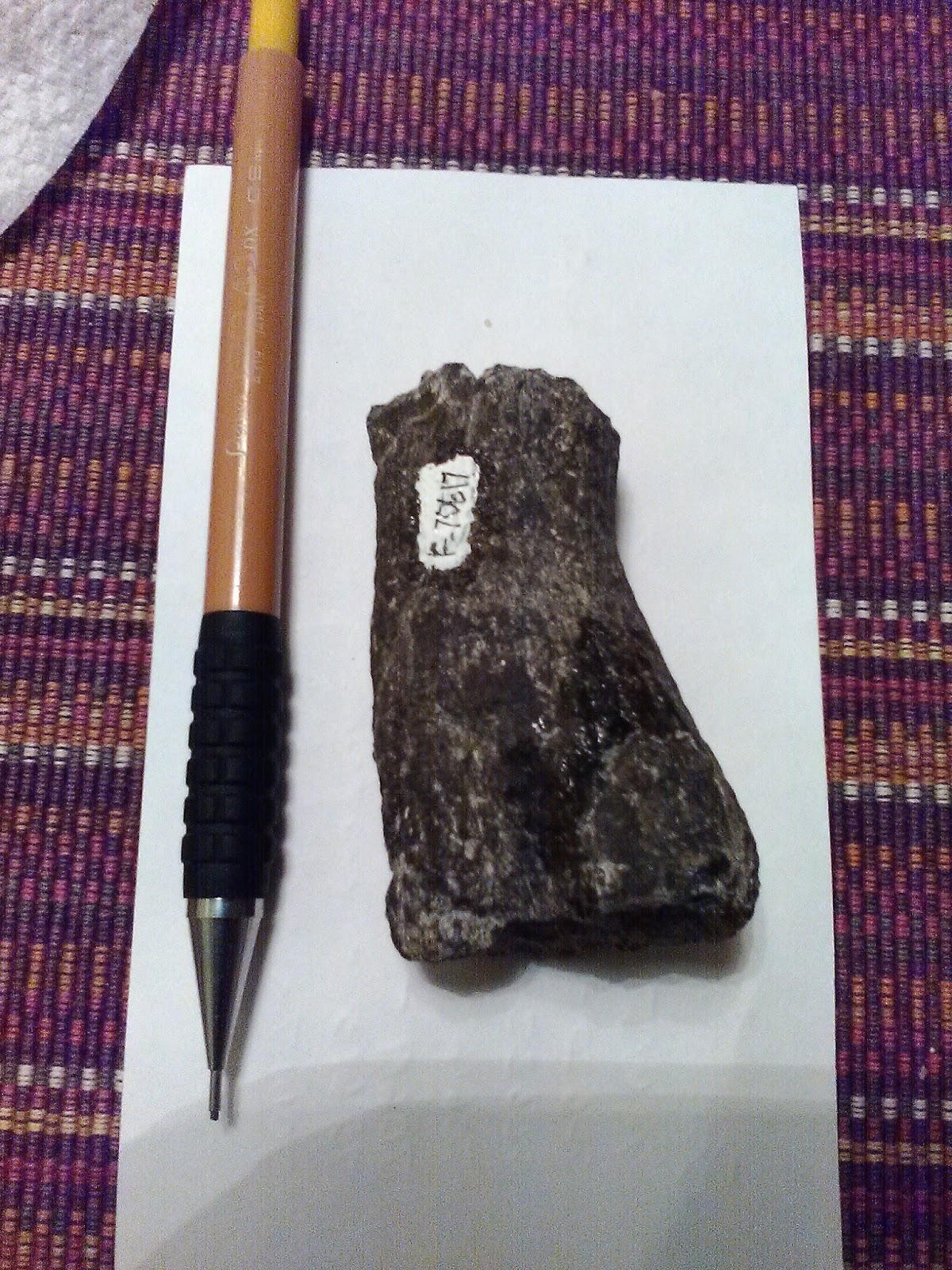
Here is a small limb or digit bone (not finished yet), again with a 3D previous bone. 
Here is what I think will be a Quadrate. We have several of these, only one other is complete. This one is much less robust than the other as well as being smaller. Nice growth sequence going on, I think.  
Last of all, I have an excellent Orthoceras. These straight versions of chambered Nautilus are common, but this is the largest one we have ever found. It is almost as large as my Exacto (R) knife!

Sincerely, Greg Carr