Tuesday, July 15, 2014

Eyes bigger than a Tennis Ball !

The skull preparation is nearing an end. I think I've only got about 20 hours to go. However I have to leave off preparing it for three weeks while I work on some houses and go fossil hunting for two weeks in the Wallowa mountains.

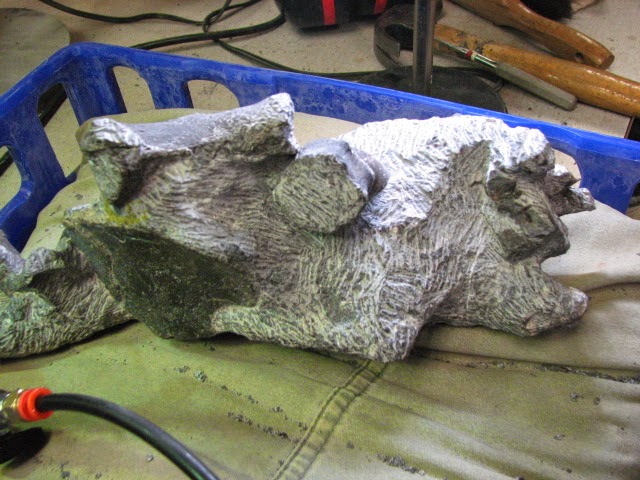
It is clear now that the rear opening is the orbit ( where the eye goes). It is very smooth inside and of considerable size. The front opening is the naris, which the animal breathed through. The breathing opening is quite large - perhaps the animal had large lungs for deep diving. This might also explain the large eyes. Deep diving requires large eyes to see prey and predators. As I remove excess matrix the skull is getting even more light and fragile, but is very elegant. I understand that this is the first 3D Thalattosaur skull ever found, and one of the very few of any kind from the Triassic.

So here is the inside of the skull. You can see the remnant of the palate just at the lower side of the naris, going back to the orbit.  We have a part of the palate with teeth, but I think it's from the other side of the skull. The sutures between the various bones are very clear here on the inside of the skull. In addition, some of the holes where nerves or blood vessels pass through the bones are also visible on close inspection.

 Here's the skull with a tennis ball in the orbit. It fits easily - the eyeball was larger than a tennis ball!

 Last, I don't remember if I've previously posted this. Here is the skull with the large break across the nose corrected . The nose droops even more than at present due to an existing offset. I intend to remove the nose, remove all excess matrix, and repair the nose so it looks like this picture (but with all the excess matrix removed, of course).  I'll be away for 3 weeks so the next post will probably be a month off.

By the way, if you are in the Portland Metro area on August 9th check out the NARG group's Fossil Festival at the Rice NW Museum of Rocks and Minerals, It is free, and a lot of fun. Bring the kids!
Sincerely, Greg Carr

Thursday, July 3, 2014

Progressive Pictures of the skull preparation

Here's a bunch of pictures of how the skull preparation has progresses. It is not finished yet, but it is moving right along. The most delicate parts are now beginning - preparing around the teeth and preparation of the very thin skull section which is only 1-2 mm thick. Both are a challenge but I'm making good progress. The skull gets lighter each day I work on it as all the excess matrix is removed.
First of all, a progressive set of pictures as taken from the inside of the skull looking out. All this has occurred over the last 7 weeks.


Next a sequence taken from the bottom looking up into the skull.


Pretty good for about 80 hours of actual work on removing rock!
Sincerely, Greg Carr

Saturday, June 21, 2014

The Inside of the Skull Appears

I've been working on cleaning out the inside of the skull, starting from the rear end (posterior) and working forward. So far I've uncovered the pineal gland opening, the (probable) braincase and the insides of the three terminal projections. The quality of the bone is amazing! Everything is intact, the bone surface is clean and there is no apparent distortion. Here is the bottom overview. The teeth and exterior of the skull are at the bottom, the midline is along the top. The remnant of the last nautiloid is still in the middle of the skull, but it won't be there long.
Here is a closer view of the pineal foramen structure and the braincase. The pineal foramen are found in reptiles. It is the groove with a rounded edge descending from the top of the skull (top in this picture too) that is vaguely bullet-shaped. The pineal gland's full function is not well understood. They definitely were a significant part of the brain and required an opening without bone to let in ambient light through skin or a specialized lens. The brain case is immediately next to it to the right side (posterior). It is not real clear in this photograph but the furthest posterior part of the braincase is U shaped (since it's broken in half) for the brain stem to exit. It would be a round hole if whole. 


The U-shaped section might be a little clearer in this shot - at the top. The braincase is the upper projection. 
You can also see how much of the inside of the skull is showing. The skull varies very elegantly in thickness and strength. The thicker section diagonally across the middle is about 1 cm thick, while the part below it is only about 1-2mm thick. Very Fragile! The lower projection is actually the Quadrate where the jaw bone articulates. It had a very large cartilage pad on the inside of the  projection which appears blurry because it points right at the camera at this angle. 

This is a clearer shot of the Quadrate in better profile. You can also see the pineal gland hole in the top of the skull on the right side - it looks like a notch. 

Last of all here's a free-hand shot:

 
I suspect it might be very interesting to do a FEA (Finite Element Analysis) on this skull to determine things like biting force, etc. The bone thickness is easy to measure (not just estimate) and the angles and curves are beautiful and elegant too.

Sincerely, Greg Carr

Tuesday, June 17, 2014

The skull, the half skull and nothing but the skull (so help me God)

Well, we have finally gotten all the extraneous stuff off the skull. I think we totaled 6 Nautiloids, 2 ammonites and 8 bones that were attached to the skull when it was removed. The only thing left not of the skull is a part of the last nautiloid that can't be removed intact. That will have to be 'blown away' since it touches the skull interior bone in multiple places. It can't be worked free without damaging the skull - and the skull is ALL-IMPORTANT! I have put in about 50 hours removing all this stuff so far.
The best thing about removing part of the nautiloid is that the interior septums of the chambers can be seen. These nautiloids do not have a completely smooth septum - they are partially convoluted like ammonites. However the siphuncle is toward the middle of the shell, where ammonites have theirs at the very outside of the shell. This proves they really are nautiloids. These will be speciated later by someone who knows what they are doing.

So anyway here are some more pictures of where we are. Interior view, anterior (front) to the left. The remnant nautiloid is the funny lump over the middle of the ruler.
 Here it is rotated,. The three projections at the posterior end show up really well. One is in the center. It will be paired with one on the other side of the skull, perhaps will be the base of the occipital condyle where the backbone hooks to the skull. The outermost one is where the jaws hinge. There appears to be a lightly ossified cartilage area on the inside of this part of the bone. The center one - who knows?
 Here is the outside of the skull - you've seen it before.
 This too - shows the teeth in the jaw line better.
 Here's a close up of the three rear projections. The last centrum was nestled between all three of these and occupied over 1/2 of the volume. It  was difficult to remove it without harm to the skull.
 And here's a view from the rear looking forward. The U-shape of the hollow skull is visible in the dark bone, which is the rear rim of the skull with matrix removed.
I'm looking forward to removing the rest of the matrix and seeing what the rest of this thing looks like!
Sincerely, Greg Carr

Saturday, May 31, 2014

Skull Preparation progress

Now that we have the skull block off the main block we are proceeding to take the other bones and invertebrates off the block to reveal the skull. Some of the interior of the skull is being revealed as we go. Two centrums, two small ammonites, a J-shaped limb bone and the Coracoid have been removed so far.

Here we are before we start. Quite a jumbled mass of good stuff jammed up against the inside of the skull.

 Here's the inside of the jaw with the front teeth at the bottom before the J-shaped bone was removed. The two removed centrums are on the side. They will be finished later.
 Here's the front teeth with the matrix partially removed from them. This is the most delicate work I have to do as the teeth are fractured and break apart extremely easy as I work around them. Lots of precision work on this!

 Block looking at the inside of the jaw to the left, the large crack that has distorted the jaw line is becoming quite visible. It may be possible to separate the two pieces, remove the matrix fill, and restore the jaw to it's original curvature. I'll evaluate this when the crack is fully exposed on both sides. Look at the nice sequence of four invertebrates tucked between the jaw and the larger nautiloid. I think they are very pretty and I think I can salvage them as well. They look like marbles, seem to be two small nautiloids and two ammonites.
 Here are some views of the skull as of 5/28, with the J-shaped bone removed from the anterior (front) end of the jaw and the 2 main teeth exposed. The jaw appears to have a bulge of bone with two teeth following it, so it looks to be complete, not broken off!
 Front teeth and jaw line exposed in profile
 Coracoid still in place.
 Now the Coracoid is removed, exposing the actual jaw line. Broken teeth are partially exposed, but it will take very careful work under the microscope to expose them all. Main teeth are exposed on the far right - you are looking down at the pointy ends.
 Here is the enigmatic J-shaped bone. I think it's a Thalattosaur Pelvic girdle bone, but I'm not sure. It still has more cleaning to be done on it, some of what you see is still matrix.
 Here is the Coracoid removed from the skull block. Beautiful bone!The large crack offsetting part of it evidently occurred as the bones reached their final position in the sediments, but before the rock hardened. It's not due to a later cracking of the rock after it hardened. Same condition applied to the large crack across the nose that offset and rotated it a little.
 And here we are as of Thursday May 29th, 2014.

Sunday, May 18, 2014

The beheading of Bernie!!

We have finally done it. The sub-block containing the skull, other bones and two nautiloids has been successfully removed from the main block. Now we can prepare the skull by  removing the other bones & fossils carefully under the microscope or magnifying visor as needed. I'm hoping that it will be complete by Christmas. Of course, I said that last year too.

The skull (or rather half-skull as it's split down the midline) first appeared in August 2013. It took several months to recognize what it was. But it has taken until now to remove enough rock to break it off. Many bones were in the way. Some were removed entirely, some had to remain connected to the block as they are tucked up into the ventral side (underside) of the skull or were touching items that touched the skull. In all, we took out 1/2 skull, 3 centrums, 1 clear limb bone, 1 Coracoid, 1 fin from a neural arch, 2 unknown bones, 2 Nautiloids and only broke 1 rib (Bernie's, not human)

The skull block was undermined enough that numerous holes passed completely under the fossils.


Then my daughter Gloria had the honor of breaking it off the block by simply prying it off with a large screwdriver. Jerry Dodson had his hands on it as it was removed, and cradled it like his first newborn. My wife Peggy was there as a spectator. Then we passed it around, ooh'd and aah'd, and finally went off to celebrate with a late lunch.


Sincerely, Greg Carr