Thursday, January 8, 2015

Plugging Away on lots of Skull Pieces

We now know that the block containing Bernie (and Ernie, Bernice, Bernard...) has at least three specimens of the same species of Thalattosaur. We have three brain cases of different sizes and three humerii of different sizes. So we've been focusing on removing identified skull fragments from the block as fast as possible. However, it is slow as explained below.

First of all, we have a complete brain case, now fully prepared. This is one reason it's been a while since the last post. This bone alone took 4 weeks (3 days per week) to remove from the main block and totally prepare. On the other hand, it's reeeealy nice, and the first one ever found with 3-D preservation. I am waiting to get it 3D scanned before I send it to Pat Druckenmiller at the U of Alaska. You can see all the little holes where the nerves exited the bone out into the body.


  I'm not sure what is up with the Occipital Condyle - normally these are round and solid, or arc-shaped surrounding the hole where the spinal cord exits. In our case, we appear to have two holes where the spinal cord(s) come out, one directly in the center of the round condyle and one above it.
 The next skull bone we have it a partial mandible. This appears to be the right side of the mandible, complementing the left side found many months ago. Here is the bottom:
 Here is the top, broken off where the bone stuck out of the concretion it was in. There are roots of 6 teeth at the right side of this view, though they are clearest under the microscope.
 And here it is from the cheek side (outside). It is furrowed and rugose, just like the skull is in that area.

 Here is the lingual side (inside next to tongue):
 And here it the mandible fragment prepared in June 2013 from the left tip of the mandible. Somehow these fit together, though it doesn't look like it was a mechanically strong joint.
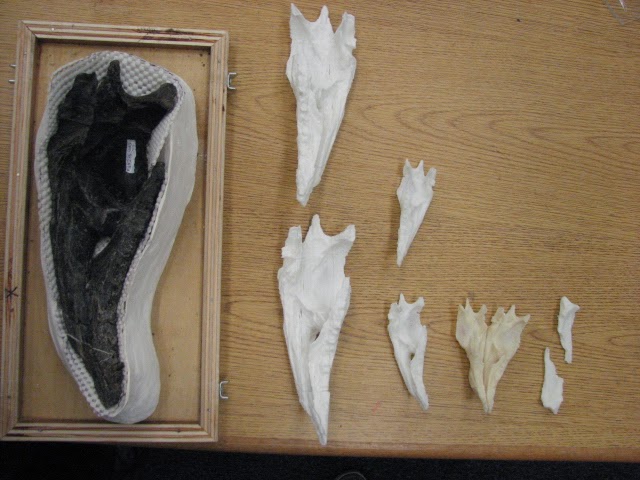
 Here is the second-largest skull fragment found to to-date. It is about 6 inches ( 16 cm) long. I can't yet place where it is in the skull, but there appears to be numerous projections on both ends. It will be several weeks before it is removed from the block, and several more then that before it's fully prepared. I can't even tell if it's the left side of the skull we already have, or part of a second skull. It is definitely a skull fragment, I'm sure of that.

Here is yet another fragment in a block removed from the side of the block to allow access to take off the above fragment. It is only about 3 inches (7 cm) long, and busted all around. It will take a couple more days work. 

Last of all, here is a shot of two of our other volunteers, Jerry and Janet. Jerry is talking to a visitor to the lab. Janet is learning how to use the Paleotool #5 under the microscope, something she never had to do while preparing Triceratops bones. Good Luck Janet!

Tuesday, December 9, 2014

Endings and New Beginnings - Three skulls!

The 'ending' of the title refers to the fact that the skull and eleven associated skull fragments have left OMSI and have gone to the University of Alaska, Fairbanks (UAk) for further scientific study. Professor Pat Druckenmiller and his graduate student Eric Metz have undertaken the task of classifying the skull and determining how it is related to the other species of Thallatosaurs. Although I'm sad at seeing Bernie leave, I know he's gone to a better place. Meanwhile I'll mourn our separation.

Kidding aside, it's been a really great couple of weeks. We have a wonderful revelation of sorts. If you remember, I posted about some unusual bones that I thought were vertebrae of a second type of animal. It turns out I was wrong in a very pleasant way. We've been excavating a third of these strange bones, and this one is not only larger but has  pieces that were broken off the two other bones. It turns out that these three are the brain cases and basioccipitals - that is, the back part of the skulls where the spinal column connects. So we now have proof of not only 3 animals, but three skulls (or at least parts of them)!!!And they all are graduated sizes, consistent with the three humerii of different sizes.
Three Basioccipitals and their Humerus's


How wonderful. This will really help us figure out how the back of the skulls were built. Also, what is interesting is that these basioccipital bones very closely resemble those of a modern Komodo Dragon! The resemblance is clear from the photograph.

Basioccipital put in the reproduced skull of a Komodo Dragon

Top side of the three - this is the lower and rear part of the braincase. 


Three brain cases / Basioccipitals two in hand, one still in the block


Here's the largest brain case / basioccipital, removed from the block but not finished. There's lots of rock left to remove. 
Here is the bone fully prepared:


Here are still more skull fragments that are still in the block:


Here's part of the mandible - note the roots of the teeth on the left side of the bone. I count five. The part broken off has probably been lost as there was no rock outside it. Still, it's not too bad for 230 million years old. 

Here's another skull piece located on a side of the block we haven't excavated yet. Pat Druckenmiller said he thought it was a skull piece, and he was right! Good Call. It's about 15cm long showing on the surface - we'll have to see what is buried in the rock.

Sincerely, Greg Carr

Thursday, November 27, 2014

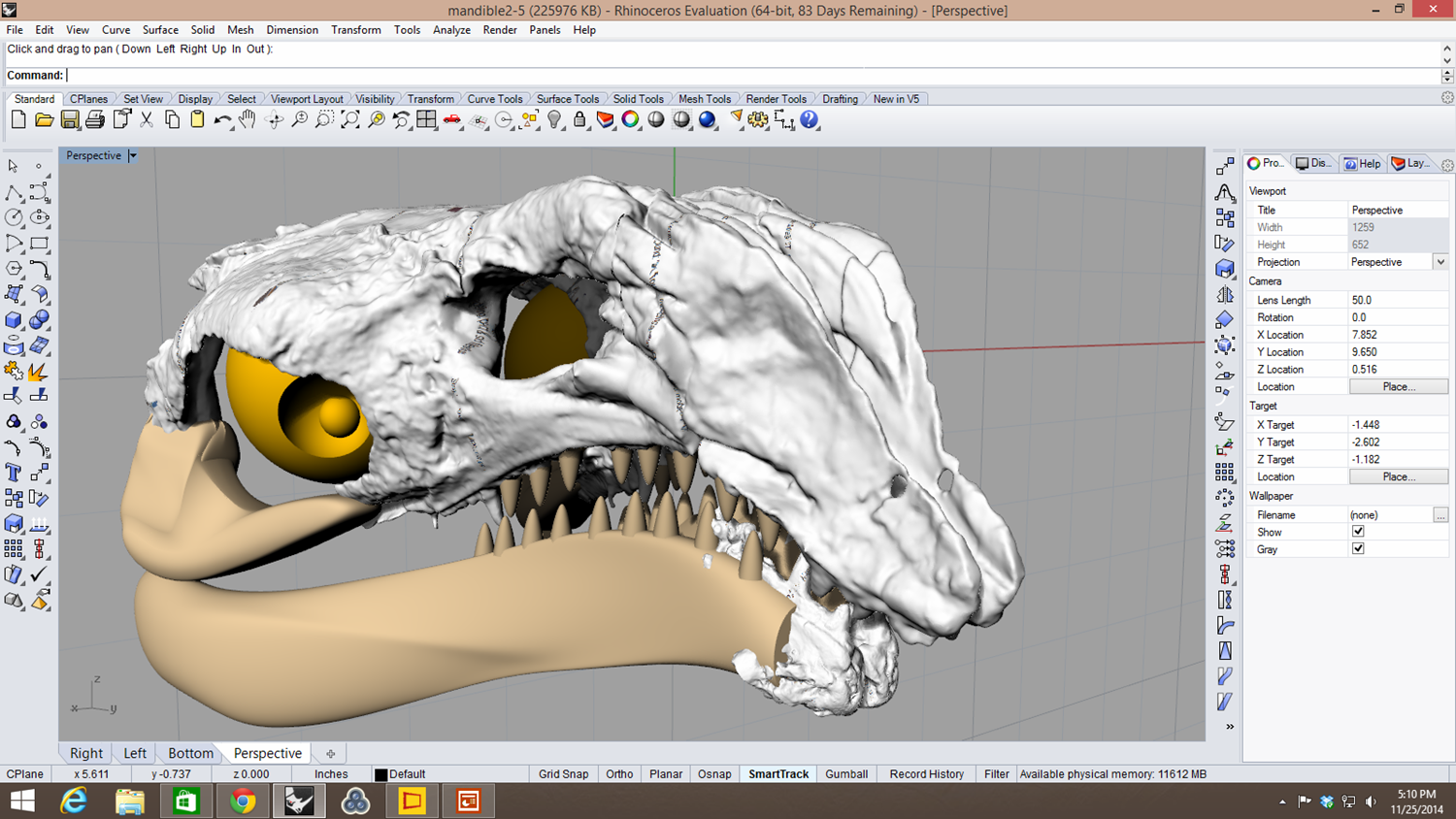
Recreating the full skull with 3D modeling programs

We continue to work on extracting bones from the main block, and getting the identifiable skull bones ready to go to the University of Alaska for proper scientific study. It will be sad to see the skull go away, probably never to return to OMSI. The skull is going to be classified (a formal scientific process) and then it will become the original type specimen for a new species (if not family or genus) of animals. At that point it will be scientifically very valuable. It will go back to the University of Oregon and will be kept in special "Holotype" storage. However, since we have scanned it, we will be able to keep 3d printed copies of it - and more!

 3D models of scanned objects can be modified in any way conceivable, and I have been playing around with the scanned parts of Bernie's skull to re-create a full skull with missing parts. I've been using Rhino software to do it, which is available for a 90 day evaluation period free of charge. It's really good software but I don't think I can justify purchasing a real copy when my 90 day period is up. So I'll just have to work fast, I guess!

Here's some screen captures of the process I've gone through. I have modeled the back art of the skull, currently missing, as an Ichthyosaur skull without temporal fenestras. It is easier that way, and seems to fit the back end projections better. In some ways the resultant skull resembles a cross between Ichthyosaurs and large Amphibians such as Temnospondyls. This may not be real, but until we get more loose bones we don't know for sure what it looked like. If it has temporal fenestras like other Thalattosaurs, the skull and mandible would be even longer than in this recreation.

So here's the process in pictures: Here is four views of the original half-skull scan.

Here it is from the right side

 Now since the skull was broken in half we can create a mirror-image copy. The nose needed to be twisted to remove some distortion so the two halves fit together nicely. Rear view:
 And a top view:
 Now we add in another potential part - the tip of the left mandible.

 So now we add a mandible of a reasonable size and dimensions, and the missing part of the skull. I have not attempted to delineate the multiple bones that these parts would be made from. Nor could I easily make them blend in evenly and smoothly to the existing bones. Something about the way the software treats the imported scans differently from the created objects makes this hard to do.

 Now the new parts are copied in a mirror-image and placed under the jaw line.
 Here are so spheres of about the right size to be eyes, placed in the orbits.
 Now I modify the spheres to incorporate some pupils. It's beginning to look really good!

 Here it is from the front. I think this animal had limited binocular vision with much better vision to the sides. My daughter Gloria says this is typical of birds-of-prey such as eagles and hawks, where the eyes can work both independently and together.
 Here's some fun - open the mouth! Looks like a Japanese monster!
 Imagine this coming after you!
 Last of all, add some teeth. These are roughly copied from one of the existing teeth as to dimensions. They were placed on the upper jaw where the roots of broken-off teeth exist, duplicating positions. The teeth in the lower jaw were placed in-between those of the top jaw. You could argue the angle the teeth make in respect to the jaw bones, but straight vertical works for me.
And here we have a re-created head of the animal!!!
Sincerely, Greg Carr

Monday, November 10, 2014

More skull bones - and proof of a second skull

I think I have mentioned that I've pulled a few bones out of a different block because I'm tired of working on the original block. It's been almost 2 years now, and although it's productive some change is needed.
Anyway, I've taken all the surface bones out of the second block. Out of 8 bones there appears to be 3 fragments of skull, 3 backbones (centrums) and 2 unknown fragments.

This is really great! I can't place two of the 2 skull fragments, but the third fragment tells me we have not one but two skulls of Thalattosaurs present. Take a look at this pair:
 I have to admit that it's clearer in real life than the pictures.

The bone on the left is part of the left hand side of the skull we already have. It fits pretty well to the right side of the skull we've been copying. The bone at the right appears to be part of the same part of the skull - left side, broken along the midline, just in front of the pineal gland. I think that makes it the frontal. Now we have two of these bones, showing that we have parts of two skulls. The new bone is also larger - the outline below on the left bone is what the right bone is. So perhaps the second skull is larger than the first skull.
 Since we thought we have multiple individuals from the humeri of different sizes, this isn't a real surprise - but it is still good news. So we just keep digging to find more bones.

We have also had a nice review of the work being done at Century high school by two seniors. Here's a link to the online article - hope it's permanent. The Oregonian Online - The Oldest Bones in Oregon

Sincerely, Greg Carr

Tuesday, November 4, 2014

Let the Printing begin!

I mentioned in a previous post that we have been scanning the skull at  local high school - Century High School in Hillsboro, Oregon. After about 16 scan sessions we have the entire skull scanned in pretty good detail. This enables us to print both the original and the mirror-image skull.

Here is half of the skull as-printed. The vertical structures under the skull are supports, automatically printed by the program to support the skull overhangs. It's not that the supports are needed to hold up the weight. Instead, the filament comes out of the moving nozzle and can't just hang in mid-air. So you need some supports to hold up overhangs until they freeze in place. The supports are made to break off fairly cleanly. The rest of the excess is then cut off with a sharp tool.
 Here is a printout of the original skull and a printout of the mirror-image. This is where 3D technology begins to show it's strengths over traditional molding and casting. Mirror images can be made with the click of a software button in 3D.

Here are the two sides held together. There is some slight distortion of the nose preventing a tight fit. However, it is still wonderful preservation. Just a little 'tweaking' with a hot air gun and they will fit.
 We have been printing out reduced sized copies for two reasons. 1) The available printers can't print such a big object in 1 piece (they are generally limited to about 8 inch (200mm) in the largest dimension) and 2) It takes a very long time to make a 3D print. Both OMSI and Century High School limit printing activities to the times the labs have people present. These prints, even at printing speeds fast enough to give a poor quality, took about 4 hours for each piece. The largest pieces below,  8 inches long, took 14 hours each!


Last, here is a short video of the assembled skull with both halves in approximately the correct configuration. The animal clearly had great sideways vision, but little or no binocular vision. And it could not see up because of the overhanging brows.It had vision more like a modern horse than a modern eagle. It does not resemble a modern iguana, crocodile or monitor lizard either. Very strange! 
Sincerely, Greg Carr

Thursday, October 23, 2014

A new block - perhaps a new Skull?

I've decided to take a break from preparing block 2 where we have found so many good bones (80+ and counting, including the half-skull). There were some visible bones on block 5 that have been intriguing me since we cleaned them off almost 2 years ago. So while Jerry Dodson continues on the main block, I've switched over for a few weeks. So here is the block 5 as-found. There are about 5 visible bones. The one most intriguing is on the upper right side, close to the light in this picture.

 Here is a closeup. It turns out that these are two separate bones, touching each other. The lower bone, with holes in it, is particularly intriguing as we haven't see such holes in the bones before.

So we set to work with the large air scribe and after about 4 hours work knocked off a block containing both these bones from the main block. Another volunteer, Janet K, will be working on a part of the block that also got broken off inadvertently during the process. It has at least 3 bones, with 2 centrums and another  (limb?) in it. After about 15 hours total work we have these two bones shown, above, now prepared. Both appear to be fragments of a skull, basically because they aren't anything else. But they don't appear to be parts of the skull we have already removed, or even parts of another skull of the same species. For one thing, they are full of tunnels (sinus?) that the existing skull doesn't have.


We already know that we have more than one species of animal here since we have more than one type of backbone. Perhaps this is fragments of a skull of the second animal. But what kind of animal? And the block 5 has at least two more bones that are not recognizable showing on the surface. I'll be preparing them next in hopes that they too are skull fragments.

Sincerely, Greg Carr