Tuesday, August 11, 2015

Back in the Saddle (Prep Chair) again

Well here we are back from our trip to Alaska. During that trip we visited :
1) The Royal Tyrrell Museum in Drumheller, Alberta- it is Mecca for dinosaur and Ichthyosaur lovers.
2) The Peace River Paleontology Research Center  in Tumbler Ridge, British Columbia - shoestring budget but great potential, especially if you love animal tracks. Visit them in the late summer for best viewing of track sites.
3) The University of Alaska Fairbanks - imagine a giant painting of Hydrosaurs under the Northern Lights!
4) A dig with the U of AF on the first Elasmosaur found in Alaska - we recovered 14 backbones, a couple of ribs and a scapula. Not bad for two days standing in ledges about one foot wide that were about 50 feet up a 100 foot cliff!
5) The Discovery Place in Prince George - nice replicas of dinosaurs including one big sauropod that stretches through three rooms.

A few notes about timing. We left in mid-May and returned in mid-July.
1) We got out of Alaska before the mosquitoes got too bad.
2) We got out of Alaska before the fires got too bad and obscured the views.
3) If you go to the Canadian Rocky Mountains before June 1st plan on camping in Banff, as other campgrounds are still closed.

Back at OMSI, I have now finished preparing a very interesting piece of skull. It appears to be from the 'nose' region of a second skull, between the Nasal passage and the end of the snout. However, it does not exactly match what would be the same section in the first big skull we have prepared. Perhaps it is from a much larger skull, and was broken off somewhere above the inner (top)(proximal) end of the teeth. Anyway here are some pictures. The 3D printed version of the first skull is in the background for reference.


Saturday, May 16, 2015

Getting ready for the big trip

My wife and I  (Peggy and Greg) have been planning a big road trip to Alaska for a number of years. This year we are finally doing it. We leave on May 18th. We plan on spending 2 months or so, driving all the way to Prudhoe bay and seeing the midnight sun. Preparations to do this have occupied a lot of my time over the last few weeks. I'm not turning this blog into a road trip journal, but I may include some Paleo-related stops such as the Royal Tyrrell museum, the peace river paleo center, ammonites in Alaska and other juicy bits.

At OMSI, we've been slowly grinding out bones and doing a lot of scanning. The student I've been working with at Century High school has gotten really good. She can scan a bone, fix all the problems and have it ready to upload to our files in about two hours. Sadly, school is almost over and I'll have to find another way to get the bones scanned later in the summer. Portland Community College has a scanner, perhaps I can do it there. Here is the latest batch of scanned bones sent off to Alaska. We have a textbook centrum and neural arch [242], two possible radii [245,246], the smallest humerus [262], the fifth braincase [265], a coracoid [263], part of a skull internal bone [247], and one bone I have no clue [257].


For new bones, I only have one strange bone that may be part of a juglar, though I'm not sure. And sadly this is all we will have of this bone. It was sheared off at the surface of the concretion - the rest is lost somewhere in space and time. The smaller bone next to it is a miniature radius, or at least it is a smaller version of the pair of bones sent to Alaska shown above. I have a still smaller one yet - hurrah for an age progression!


Nestled against this bone was the first loose tooth we have found. I think it's a palate tooth, as it is very small. The bit of bone visible in the photo is about 2/3 root+bone, and only 1/3 was the exposed bone. The crown is only about 2 mm wide and 2mm high. I tried to get a picture through the microscope eyepiece. It is perfect - even the grooved surface of the  tooth is present. 


Last of all, we had some fun in the lab this last week. The traveling exhibit being installed this week is "Ripley's Believe it or Not"(R). One of the exhibits got broken in shipment. It is the actual skull of a two-headed calf! Since we deal with broken bones a lot in the Paleo lab, the exhibit guys asked us to repair it. I undertook the job. The bone structure, as you can expect, is bizarre, There are two noses, three orbits, the jaw is a "W" shape, and being a newborn the bones are extremely fragile. But with the help of modern glues it's back together, and on exhibit!


Sincerely, Greg Carr

Tuesday, April 21, 2015

Printing more skulls and grinding out the bones

There has been two main activities in Bernie's 'life' - making more full-size copies of the skull, scanning more bones and grinding out new ones. I have just completed the second full-sized skull, this one in white PLA. I think white gives you the expectation of old bones, although Bernie's bones are actually dark grey.

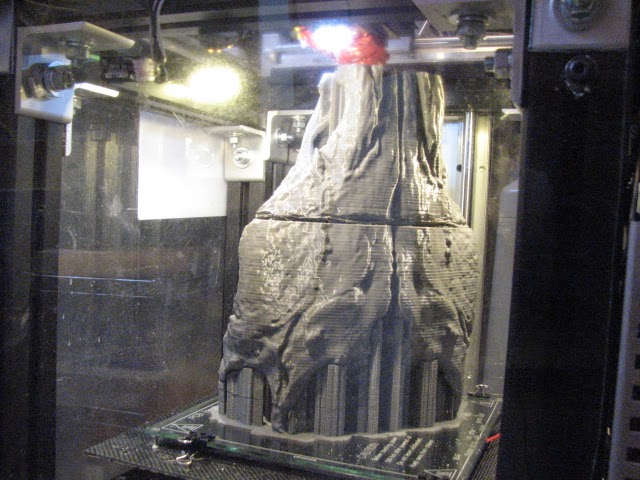
I found that printing the skull in one piece to be rather impractical. It takes over 3 days, and the longer the duration of the print the more chances to have a failure. Also, the standing-up position requires a lot of supports that eventually will become waste. So I have split the skull into two halves - front half and back half - and print them based on the flat 'cut' surface. It cuts the print time to about two days, one per half, and had much less waste and much more mechanical stability during the print. So here is the view of the first front half through the glass build plate before it was removed.

Of course, after you print two halves you have to glue them together - superglue to the rescue (again). 

The assembled skull is really awesome - like an alligator I have requests for about 5 of these already. Here is a couple of movie clips showing the machine in action printing these half-skulls: 


As far as scanning, that is proceeding with about two bones per week being scanned. We have just sent up the second shipment of bones to the U of Alaska, Fairbanks, to Pat Druckenmiller. His graduate student, Eric Meitz, will be writing up the classification of this animal as a Master's theses. I am only sending up scanned bones so we can make copies down here as desired. 


As for grinding out bones, we have found a very nice combination. A couple of months ago we discovered a rounded shell freed by an errant hammer blow. it wasn't quite like an ammonite nor nautiloid. After preparation, it appears to be some type of a slipper snail. And in the open of the skull we found two centrums and two ammonites! very cool combination


Last of all , I have now prepared the fifth (5!!) braincase. This one is more broken than the others, having lost most of one side. However this opened up the brain chamber and allowed me to almost fully prepare the hole that the brain sat in. It is amazing how big the hole is inside one of the braincases!


Last of all, my wife Peggy and I will be taking an extended trip to Alaska starting in mid-May. So I may have one more posting before then. I don't intend to make this blog a travelogue, so I'll limit my posting to fossils we find during the trip . 
Sincerely, Greg Carr


Tuesday, April 7, 2015

First full-sized print of Bernie's skull!

I have finally gotten confident enough that I attempted to print out a full-size skull. This includes both halves, something not seen for about 230 million years. It was really a marathon. It took a total of 76 hours, nonstop,  and used almost a full roll of PLA plastic. If I used ABS it would take the same amount. At times I had to apply superglue to the supports as it was building (still moving, dodging the moving extruder head) to keep the slender supports from wobbling and breaking off. I definitely need to have the model cut in half so that I can print it flat side down so it would be more stable and require less supports. So here's some pictures:

Several hours after printing started, you can see the 'raft' on the baseplate and the supports the slicing program adds to hold up overhangs.
 Here is one of the problems - the back of the skull has projections . In this build, these projections start out small and grow. However when they get about 1/2 inch (2cm) they want to flop over and break off. I had to manually intervene with superglus and glue them in place WHILE IT WAS STILL PRINTING! Pretty crazy, right?
 Still ongoing - after about 1 day.

 I don't know what happened to cause the large discontinuity across the print - perhaps the filament jammed?
 Here's a shot from the side after almost 2 days of printing.
 Here it is almost 3 days of printing. Still hanging in there.
 Here it is finished after 76 hours of printing - 3 days and 4 hours.
 Here is a top view before I removed it from the printer.

 And finally here I am holding up my trophy! Glass build plate still attached.What a monster - I'm glad I wasn't around then!

Sincerely, Greg Carr

Thursday, March 26, 2015

Finished with two "Text Book" bones

I have finally finished preparing two bones that could be in a textbook if any was ever written about Bernie. One is the forth braincase - a great bone. It is 30% larger than the previous one, and in great shape. I prepared out the rock that is in the center of the bone as much as possible. This illustrates how that branch of the brain looked. I also prepared out two of the larger nerve passages (one on each side) though I don't know which nerve it would be. The Occipital Condyle (where the backbone attaches to the skull)  and the Foramen Magnum (here the spinal cord comes out of the skull) are very strange. The OC is round with a depression in the middle. It is like a ball-and-socket joint found in a lot of reptiles, but it's reversed! the socket is on the skull side, not the backbone side. Huh?  And the FM is very large and not round out all. Double Huh??

The second bone is a centrum with the attached neural arch. This is only the second bone pair we have found, as normally the neural arches separate from the centrums at the cartilage joint. This bone pair is not only complete, it has the bumps on the side where the ribs connect to the backbone [diapophysis and parapophysis] and the bumps where the neural arch connects to the ones before and behind [anterior and posterior zygapophyses]. Very nice bumps - I really need to know how to pronounce the names. Both of these bones will be scanned next at Century High school after spring break.
So here are some pictures, the result of six weeks of work, 3 days per week:
 First the forth braincase by itself:


Next, the third and forth braincases side-by-side


 Last of all the Centrum-Neural Arch pair:


Sunday, March 22, 2015

Little Big Bones - Baby makes Five???

While preparing the 4th braincase I have encountered several small bones that appear to be from an infant Thalattosaur. They are two centrums (one from last year), what could be a leg bone and what could be a pelvic girdle bone. Here are some pictures:

Here is a plain centrum recovered in 2013. It shows the 'hour glass' scar where the neural arch connects, but no neural arch was found. In most cases the arches separate from the centrums at the cartilage joint. Without the neural arch it wasn't clear if this was just a bone at the end of the tail (from a larger animal) or a bone from a very small animal.
 Here is the recently found centrum with a partial neural arch attached. With the neural arch it must be one of the body backbones (instead of the tail). Thus it must be from a  very small individual = our 5th  animal! I hope we can find the skull for this one.
 Here's a top view of the small one and a normal sized one.
 Here is a different bone. It may be part of the pelvic girdle, though I'm not sure. The bones have 'growth areas' in three sides and a smooth saddle-curved surface on the side furthest from the camera. However, the nerve holes in the two bones don't correspond, so they may not be the same bone.
 Sincerely, Greg Carr