Sunday, October 30, 2016

New non-Thalattosaur finds from the Brisbois formation

This summer, as I've already posted, myself, Gloria my daughter and Eric Meitz, a graduate student, went back to the Brisbois formation to get more information for Eric's paper. We did get the needed information. We also hoped to find more "Bernie Blocks' as we call them, containing these wonderful bones. In this, we were disappointed - no more blocks found.

However, I did find something interesting from the same formation. On my way from Portland to Wyoming (to dig dinosaurs at the world-famous Como bluffs) I did excavate a rock plate covered with cephalopod fossils.

The plate was a loose rock, buried just below the soil, broken in four pieces, with one corner showing. It was completely covered with small conical fossils called Rostrums from an extinct squid-like animal.  However, which animal is not clear. 

One type of cephalopod is the Belemnite. Belemnites are found in the Jurassic and the Cretaceous ages, dying out along with 60% of all other life at the end of the Cretaceous. They may have existed back in the Triassic, but have only been found in one formation in China back then (and some paleontologists question this). If these really are Belemnites, this could be a "Really Big Find".

Another type of cephalopod is the Atractite. These animals are found in the Triassic formations, especially in the Triassic Hosselkus limestone of northern California and other formations in Nevada. They date from the same age as the Brisbois (Carnian) and of course are physically close to this formation - only a few hundred miles away. The Atractites are sort of a mixture of Orthoceras (straight Nautilus) and Belemnite (cuttlefish) but in reality they are their own type of animals - the AULACOCERIDA. They existed from the Carboniferous to the Jurassic, 130 million years or so. 

If I was a betting person, I'd bet these are actractites. However we'll probably have to do some sectioning and microscopic examination to say for sure. And we'll have to do some serious work to decide if they are an existing species or a new species. In any event, these certainly are the first fossils of their kind found in Oregon. 


 I intend to take a group back to the site during spring or summer of 2017 to look for the layer they came out of. We'll undoubtedly have to do a cleanup of the loose soil on the slope, like a stratigraphic column, and look at the layers. With work we should be able to find the originating layer and collect some more of the specimens. I also intend to look for more thalattosaur bones as two loose bones were found in the same general area.


Sincerely yours, Greg Carr

Saturday, September 24, 2016

Back to the Dig site for Science

This summer myself, my daughter Gloria and Eric Meitz from the U of Alaska Fairbanks spent 6 days in central Oregon in a scientific investigation of the Brisbois formation. This is part of Eric's classification paper on the Thalattosaur. By the way, the local pronunciation of the name is "Briz-Bo", not at all like the original French name.

One of the activities was to do a stratigraphic survey of the area immediately around where the 'Bernie Block' was found. First, after re-locating the original site, we cleared all the loose soil off a strip from the top to the bottom of the roadcut.

Her is my daughter Gloria "In-Situ"

 Here are Gloria and Eric looking at the lower end of the cleared strip.


 Here is the cleared strip. The squarish blocks at the top are a layer of 'indurated' shale (just harder shale). The rock layers are almost parallel to the surface of the roadcut, with the younger overlying layers on top as you progress top to bottom and left to right. The rocks to the right of my hat are the layer that the Bernie Block was located in, and the depression above the hat is where the block was. This layer is mixed up, not layered, and contains lots of 'clasts' (solid rocks). This is evidence that the 'Bernie Block' was transported to this site as a result of some sort of mass sediment movement and did not originate here.

Here is how we left the site. The white object on the pole is our Totem, a full-size 3D printed copy of Bernie's skull, along for the trip. Later on I gave it to Miriam Bernard as a thank-you gift.

After we excavated the site, we spent several days going around to every possible outcropping of the Brisbois formation on 5 different ranches. Unfortunately, we didn't find any more "Bernie Blocks'. It may end up that this one block is all we'll ever get. Although it's a somewhat depressing thought, the block itself is such a wonderful specimen that I'm always thankful that we found it.
Sincerely, Greg Carr 


Wednesday, June 29, 2016

Ho Hum just another skull fragment and limb bone

It is getting rather routine to find skull fragments and great limb bones. So much so that I forget that whole animals used to be classified by one or two bones. I also forget that five years ago I'd die to have such a wonderful find of bones. I guess familiarity breeds contempt, and I've certainly become familiar with Bernie.

By my latest count, including skull fragments and brain cases, we have about 23 bones that are associated with heads! This is an incredible number of these important bones. Even the 'broken' bones are very interesting since the majority of the breaks are along suture lines of the skulls. This implies the bones were weathered and all flesh gone when they were buried, weathered to the point that the skull bones separated along the natural suture lines.

Here are the latest bones I have prepared; first the maxilla I talked about at my last post. This is the one with tooth abscesses.


 Next we have yet another skull fragment. It shows some nice suture separation.


Here is where it fits on the skull - looking from the bottom side. It sets midline, around the eyeball orbit.


Last, here's another limb bone. The end closest to the outside of the concretion was difficult to prepare as somehow it lost color contrast with the matrix and the structure didn't show up well. At first I wondered if it was a piece of coral. It did turn out to be a rather nice limb bone, with the normal incompletely ossified ends that we find from this group of animals.


Now back to preparing another batch of centrums (one with a nice neural arch) 
Sincerely, Greg Carr

Thursday, June 9, 2016

Sometimes, life is the Pits

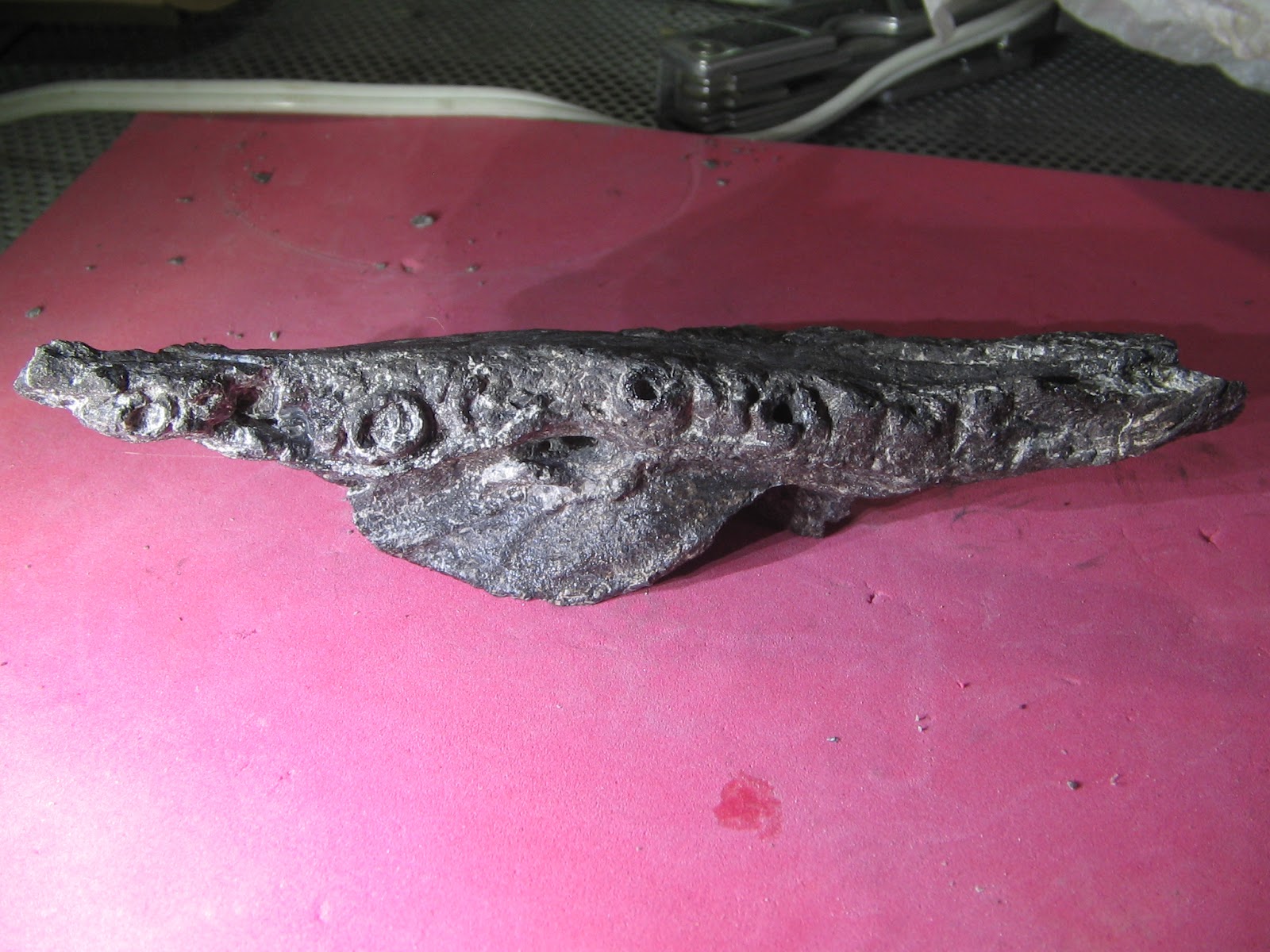
I've been working on a great piece of the upper jaw of our Thalattosaurs. I just got it finished today - still have to scan it before it goes to Alaska.  It has two wonderful new things to teach us that I haven't understood before. Here is the inside (lingual) side of the jaw.

And here is the outside   (Bucal). It is 14.8cm long (almost 6 inches). 
The first item is that this upper jaw, containing part of the hard palate, has a large vomeronasal pit. This pit is located at the outside edge of the palate where it hooks to the tooth row. These pits are smelling organs used in conjunction with the animal's tongue. Think of a snake or a monitor lizard - they put out their tongue, wave it around a bit, then retract it. Out in the air the surface of the tongue absorbs molecules that we refer to as 'odors'. Upon retraction the tongue tip is inserted into the vomeronasal pit, where the molecules come off the tongue and attache to smell sensor cells on the walls of the pit. In this way some reptiles have an accurate sense of smell.


 Why is this important? - because these pits have not been identified in this type of animal before! Preservation of other hard palates hasn't been good enough to see them clearly. This pit is quite deep, over 1 cm and almost pierces through the top of the palate. The bone at the top is less than 1 mm thick. I think this has major implications for the lifestyle of these animals. Smelling your food in the water, perhaps, along with excellent vision to hunt them down in deep water?

The second 'Pits' in this essay are concerning the teeth. There are 6 major teeth in this jaw.  All of these teeth have been broken off at the bone line. They all show extensive abscesses through the dentine down into the jawbone! This can tell us much about the teeth of these animals - they are very different than lizard or dinosaur teeth and much more like mammal teeth.

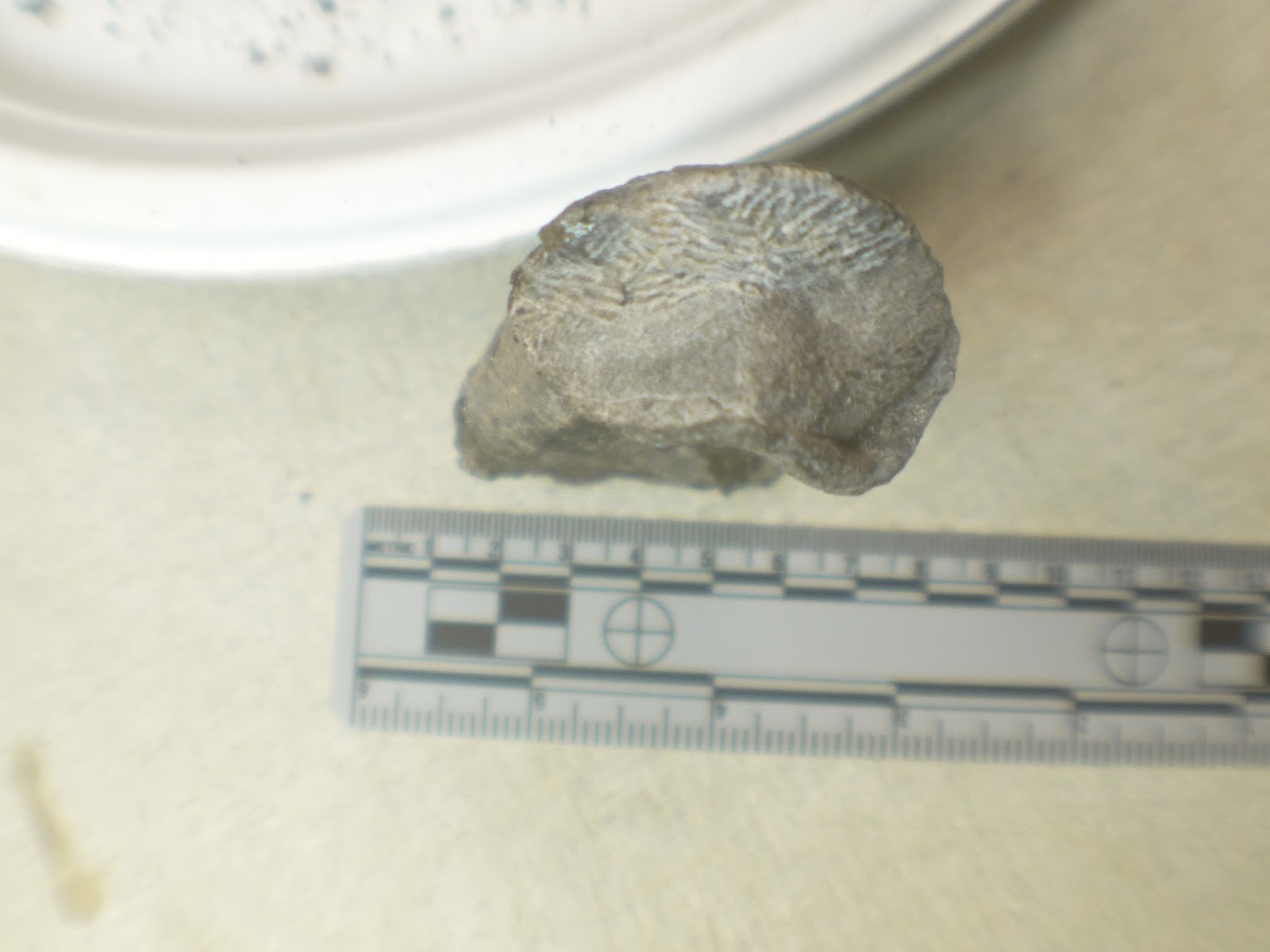
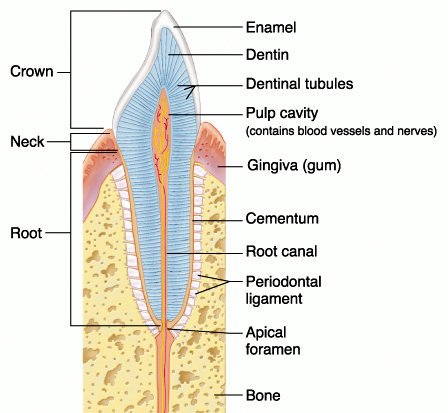
Here is the biggest tooth - it is about 9mm across. The most prominent ring is the hard enamel, which is the hardest part of the tooth. The enamel is broken exposing the dentine inside the tooth, where mammals have their blood vessels and nerves. This is what is removed by the dentist when you get a 'root canal'!
 This did not happen at death - if the tooth was broken at death, the dentine would still be filling the inside of the tooth and it would be relatively flat-topped. Instead, we have a pit where the dentine rotted away before death.

Here are two other teeth. As before, there are very deep pits on the inside of the tooth inside the ring of enamel. One of these pite is only about 2mm diameter but over 8mm deep! And there is still matrix at the bottom - I can't see to prep it out deeper.
 Here is the most severe pit of all. You see the two rings of abscessed teeth  - in between there is a hole where half the tooth enamel is still present, but the entire other half of the tooth and the surrounding bone is missing.
 This side view shows how much bone is missing - the hole is about 12mm long, 6mm wide and about 8mm deep. This animal was probably hurting!
Older dental abscesses are known, including one from a Permian animal. http://blog.everythingdinosaur.co.uk/blog/_archives/2011/04/20/4799483.html  The authors of that paper concluded that these were true real-life dental problems and that their animal did not frequently shed it's teeth. Dental abscesses are unheard of in modern lizards, and not very common among dinosaurs since diseased teeth are merely shed and not allowed to decay. Perhaps Bernie's type of animals did not shed their teeth either? 

Sometimes life is the Pits. 

Sincerely, Greg Carr

Monday, May 30, 2016

One Mystery solved - it's a jaw fragment!

I've been working on a small block that is check-full of bones. We started uncovering a skull fragment last week, and I thought it was part of the top center of the skull, along the midline of the pineal gland. This afternoon took it off the block.

Now that I've got it off it is clear that it is something else - it's about 2/3rds of an upper jaw, left side! There are lots of teeth, or at least teeth roots, and the lower part of the nasal passage and the hard palate. The hard palate has a different shape that the one in the original skull which is apparently broken. This one is more intact.

I'll have to wait until I get back to OMSI ( I'm sick this week) to finish the teeth with a Paleotools #2 - my modified Chicago Pneumatic air scribe is just too damaging for the teeth. I learned long ago that the teeth are so fragile that only the most delicate tools can be used.

This fragment of jaw may be from the other half of the semi-skull we already have, or may be from a different one. We'll have to take some accurate measurements to tell.

Anyway, it's great to get more teeth. It has been about 2 years since we found a fragment with teeth and/or teeth roots.
Sincerely, Greg Carr


Wednesday, May 25, 2016

Two more skull pieces!


So right now I'm working on a block at home and a block at OMSI. The block at home was originally located close to the original skull, about 10 inches (25cm) away. It is a lovely little block with a whole cluster of centrum (backbones) at one end, plus most of a large neural arch with some ribs thrown in for good measure. I think there are 8 or 9 centrums. Although they look like they are articulated, they are not. They are different sizes and orientations so they came from different individuals or different parts of the backbone. Too bad. Anyway, I was going to keep the block pretty intact and leave it as an esthetic piece since we already have good single specimens of all these bones.


At the other end of the 'home block' there were initially two small fragments of bone glued back on. The way this works is that a smaller block is broken off a larger block so we can work on it, usually along natural fracture lines. The bones that cross the fracture surface are removed from the smaller block and glued back onto the other block, so that the bones are made whole again. So we started out with two small bone fragments separated by about 3 inches (7.5cm). Preparing these small pieces of bone did not immediately make clear what they were. But it did become clear that they were parts of the same bone. One side of the bone is now prepared, and it is another section of a skull centered around the pineal gland. I think this makes it the 5th specimen we have from this section of skull! And first measurements indicate that it is the largest to-date! It is amazing how a piece of bone 5.5 inches (14cm) can hide in a block of rock almost completely when the rock is only 7x10 inches!

So I'll have to remove this skull fragment from the block for scientific study. The other end with all the centrums can remain intact as a showpiece, unless something else comes up!


As for the other skull piece, it's at OMSI. I started on a new section of block 1 and uncovered the end of a strange item. I couldn't really tell if it was a piece of bone or a piece of coral. It was not as dark as normal bone, but had the correct internal structure. It did not power up black when touched by the air scribe - it was grey like coral. I decided to treat is as a bone . I'm glad I did since it turned out to be a nice limb bone.  There was a 'small spine' next to the limb bone that looked like a neural arch. 

When I got the limb bone undercut and ready to remove there were some small scraps of bone showing at the bottom of the cust. After knocking off the limb, I realized that I had broken completely through the lower end of the 'small spine". It is not a neural arch, as it is rapidly expanding into a big section of bone. It is a piece of skull, I think it is the middle along the centerline. We will tell more as we excavate more. Unfortunately, it will require practically cutting the big block completely in half as it is imbedded directly in the middle, pointing straight into the center!
Sincerely, Greg Carr


On the left we have the skull piece  - the reminder is still in the block. The right piece is the limb bone. 


Monday, May 23, 2016

Back in the Saddle Again - Recreating a full skeleton

I've taken off several months from writing the Blog since I had a lot of things to do this spring - doing taxes for H&R Block, refurbishing a rental house, letting my right hand rest from air-scribe work, etc. But I'm back and proceeding at full speed ahead! (to mix metaphors)


I've been working at recreating a full size skeleton of a Thalattosaur. As readers of this blog know these bones are scanned before being sent off to Alaska for study. I can scale them in X,Y or Z dimensions using the 3D printing software. I have now printed out a full set of backbones based on a well-preserved Centrum+Neural Arch  specimen from Bernie. I scaled them and numbered them based on a well-preserved Miodentosaurus Brevis skeleton from China. I then added some 1/4 inch (6mm) foam pads to mimic the disks between the vertebrae. The resultant skeleton is about 13 feet (390cm) long. I'm not too worried about the exact length - we have bones of animals from 2 feet to 30 feet (0.6 to 9 meters) so any animal in that length range would be representative of a proper Thalattosaur. There are some significant challenges to printing out a 30 ft skeleton, however!


Next most common bones are Ribs. I made up a full rib in cedar wood, again based on the Miodentosaurus, since all the ribs recovered here are broken. I then made a silicone mold and cast about 52 copies! Boy, that sure is a lot. These copies will be shortened to match the Mio... bones and then mated up to the appropriate body vertebrae. I have chosen to hook the ribs to the centrums with small supermagnets. That way the ribs are removable for transport or storage.


The centrums themselves are strung on steel rods passing through holes where the spinal cord ran in the original bone.The rods are slightly less than 4 feet (102cm)  long so they will fit in a 'standard' display cabinet. This way the skeleton can 'swim' through 4 sequential cabinets at rock shows. It also makes it much easier to transport.

After the ribs I'll be working on tail chevrons and limbs. I will be attending a  National Federation of Rock Club show in late July, and Eric Meitz will be presenting at the SVP (Society of Vertebrate Paleontology) in October. I hope to have the skeleton, in whatever state it is, displayed at these shows.

I'm also preparing still more bones from the original matrix blocks. One of the original large blocks 200+ pounds (100+ Kg) is yielding another nice limb bone. I'm also working on a smaller block at home where I have a nice boom microscope. In a block about 10 inches (25cm) I have at least 8 centrums, two neural arches, two rib sections, and a very nice skull fragment at least 5 inches (12cm) long! And I have yet to expose all the bones in it! That will be for the next post (soon) I promise.
Sincerely, Greg Carr