Tuesday, January 10, 2017

Brains, Master ... Brains!

This post is about all our braincases. Braincases have to be the most complicated 'single' bones we have found - they have very complex shapes. And we have lots of them - 8 of them, complete or in parts! Considering that no other Thalattosaur braincases have been found / or are inaccessible, I'd say that is really crazy, even for Bernie!

So overall we have 8 braincases or parts of braincases. Six contain enough of the structure for us to be sure they are unique. Two are fragments that apparently don't fit on any of the other larger parts, so I'm confident that they represent unique individuals as well. Given that we also have bones from a vey small individual and a bone from a very large individual, this brings us up to a total of 10 individuals in this find!

Here are pictures of the braincases I have copies of. Two of the original braincases were sent to Alaska before I got a chance to scan them, so I don't have the files to print 3D copies. The two fragments are at the lower left. And the grey one on the lower right is the latest one that I've just finished preparing.


 The 'braincases' actually don't enclose the whole brain - only part of it. The rest nestles up against the roof of the skull and between the eyes. So remember - when you are ever attacked by a Komodo Dragon or Thalattosaur, a sharp stick sideways through the eye, brain, and out the other eye is the way to kill them!
Here is a short video about preparing the braincase. Sincerely, Greg Carr

Here a couple of highlight pictures to show where braincases fit into the skulls. The backbones attach to the skull at the Occipital Condyle, with the hole for the spinal cord just above. 


Tuesday, January 3, 2017

A box of bones off to Alaska - and yet another Braincase

Work at the prep lab at OMSI continued this fall. I was teaching a lot, so I could only work at OMSI one day a week. I began to take the prep work 'home' to finish up the bones. In November I was lucky enough to get a lightly-used PaloTools #1 air scribe for a good discount from someone selling it on Ebay. Tools from PaleoTools almost never come up on Ebay - everyone keeps using them, I guess.
I have also gone back into the inventory at the OMSI display case to ship a set of neural arches up to Alaska. They generally have small delicate psrts to them if they weren't broken during fossilization. Some of them I had to finish up with the PaleoTool#1 as it is more delicate than the ones we have at OMSI.

So here are the pictures: A set of 3 centrums plus a Radius ( so I've been told) on the block being removed.

And here it the Box 'O Bones I'll be sending to Alaska - 4 centrums, 8 neural arches, one Radius, and one more skull fragment. This skull fragment, like many others, is from around the Pineal gland / brain area. This must be a particularily tough piece of the skull as we have 4 fragments that contain that section.

Last of all, I am currently working on yet another Braincase - this makes Six (6)!
You can't really tell from the photos, but it is broken through the main body and there is only about 1/3 - 1/4 of the case left. . That's OK as it will let me prep  the brain mold internals plus all available nerve passages. The brown object is a life-size 3D print of one of the complete braincases. Very complex bones!


Sincerely, Greg Carr

Wednesday, December 14, 2016

A Pair of Quadrates

Quadrates are a very funny bone. They are part of reptile skulls and are not found in mammals. Actually they do exist in mammals - as the 'anvil' - one of the inner ear bones! Amazing how they got there.

In reptiles they still have a structural role. They lie between the skull proper and the jawbone. The jawbone (Mandible) pivots on the lower end of the quadrate. The upper end of the quadrate connects to projections out the back of the skull. These thalattosaur quadrates are unusually large as seen in this selection of some thalattosaurs and some other reptiles of the same era.


Here we have three bones that all appear to be quadrates. One is quite worn, and although interesting it is so incomplete that it doesn't tell us much about the thalattosaur quadrate.

However we now have two nice quadrates that are the same bone. Here is one in the rock, and one a 3D copy of one sent to Alaska. 


As I write this, all three original bones have sent to Alaska. But I have printed out life-size copies of them. The one on the left is the worn one. The center one is very robust, and the right one is the newest, very gracile and delicate. The two bones are almost the same length. One is 16.6cm, the other  more robust is 17.6 cm. This is only a 5% difference. By a strict scaleup, the larger one should be 117% of the volume of the smaller one. However, since we have the 3D scan, we can accurately know the larger, more robust bone actually is 300% of the mass of the smaller one. In short, it actually is much more robust while being almost the same size. 


So we have two bones, essentially the same size, very different in strength and robustness. What this means I leave for other experts. I would suggest it is a growth difference - the graceful bone is from a younger animal, the robust bone from an older animal with much stronger bite and skull bones. Perhaps the skull grows quickly to a large graceful form which thickens and becomes much stronger as the animal ages.
As an option, it could be a sexual dimorphism - Females tend to be larger than males in reptiles. This is less likely in my humble opinion.

So enjoy and ponder - did thalattosaurs have tall gangly teenagers that grew into strong, robust adults?

Sincerely, Greg Carr

Sunday, November 6, 2016

Finally - something other than Centrums - in fact, a whole Bunch More!

It seemed like lately we have only been finding centrums and neural arches in our blocks. We have about 4 totally prepared & sent to Alaska, 3 in the works and 5-6 still showing on the blocks. However, things are changing and we now have a plethora of other types of bones.

I am currently working on one of the large blocks (#1) at OMSI and have uncovered a bone with teeth. This is either a premaxilla (front upper jaw) or mandible. Unfortunately, the bone had been split due to natural weathering, being close to the surface of the block. I think it can be salvaged, but there may be some teeth missing. These first two photos show both halves of  the bone, split down the midline due to natural cracking. It is about 4 inches long.
 And here is a further split, this time right directly down through the teeth!  By my count there are about 9 large and complete teeth. Although this is an unfortunate split, it gives us an excellent view of the tooth internal anatomy. I'll be regluing these with Vinac (R) so that they can be easily unglued for examination. It would be hard to do better than this if you tried!  It will take a lot more labor to get these removed from the block and prepared for shipment. Teeth are particularily hard to work with as they shatter easily.


As for other bones, I'm also working on a block at home in my off-hours. This smaller block was between the two larger ones and is very rich in bones. I already have centrums, ribs, gastralia, and others. This bone appears to be part of the post-orbital. The remainder should be on one of the other blocks on the facing side. This is shown with a 3D printed copy of a post-orbital found previously.


Here is a small limb or digit bone (not finished yet), again with a 3D previous bone. 
Here is what I think will be a Quadrate. We have several of these, only one other is complete. This one is much less robust than the other as well as being smaller. Nice growth sequence going on, I think.  
Last of all, I have an excellent Orthoceras. These straight versions of chambered Nautilus are common, but this is the largest one we have ever found. It is almost as large as my Exacto (R) knife!

Sincerely, Greg Carr

Sunday, October 30, 2016

New non-Thalattosaur finds from the Brisbois formation

This summer, as I've already posted, myself, Gloria my daughter and Eric Meitz, a graduate student, went back to the Brisbois formation to get more information for Eric's paper. We did get the needed information. We also hoped to find more "Bernie Blocks' as we call them, containing these wonderful bones. In this, we were disappointed - no more blocks found.

However, I did find something interesting from the same formation. On my way from Portland to Wyoming (to dig dinosaurs at the world-famous Como bluffs) I did excavate a rock plate covered with cephalopod fossils.

The plate was a loose rock, buried just below the soil, broken in four pieces, with one corner showing. It was completely covered with small conical fossils called Rostrums from an extinct squid-like animal.  However, which animal is not clear. 

One type of cephalopod is the Belemnite. Belemnites are found in the Jurassic and the Cretaceous ages, dying out along with 60% of all other life at the end of the Cretaceous. They may have existed back in the Triassic, but have only been found in one formation in China back then (and some paleontologists question this). If these really are Belemnites, this could be a "Really Big Find".

Another type of cephalopod is the Atractite. These animals are found in the Triassic formations, especially in the Triassic Hosselkus limestone of northern California and other formations in Nevada. They date from the same age as the Brisbois (Carnian) and of course are physically close to this formation - only a few hundred miles away. The Atractites are sort of a mixture of Orthoceras (straight Nautilus) and Belemnite (cuttlefish) but in reality they are their own type of animals - the AULACOCERIDA. They existed from the Carboniferous to the Jurassic, 130 million years or so. 

If I was a betting person, I'd bet these are actractites. However we'll probably have to do some sectioning and microscopic examination to say for sure. And we'll have to do some serious work to decide if they are an existing species or a new species. In any event, these certainly are the first fossils of their kind found in Oregon. 


 I intend to take a group back to the site during spring or summer of 2017 to look for the layer they came out of. We'll undoubtedly have to do a cleanup of the loose soil on the slope, like a stratigraphic column, and look at the layers. With work we should be able to find the originating layer and collect some more of the specimens. I also intend to look for more thalattosaur bones as two loose bones were found in the same general area.


Sincerely yours, Greg Carr

Saturday, September 24, 2016

Back to the Dig site for Science

This summer myself, my daughter Gloria and Eric Meitz from the U of Alaska Fairbanks spent 6 days in central Oregon in a scientific investigation of the Brisbois formation. This is part of Eric's classification paper on the Thalattosaur. By the way, the local pronunciation of the name is "Briz-Bo", not at all like the original French name.

One of the activities was to do a stratigraphic survey of the area immediately around where the 'Bernie Block' was found. First, after re-locating the original site, we cleared all the loose soil off a strip from the top to the bottom of the roadcut.

Her is my daughter Gloria "In-Situ"

 Here are Gloria and Eric looking at the lower end of the cleared strip.


 Here is the cleared strip. The squarish blocks at the top are a layer of 'indurated' shale (just harder shale). The rock layers are almost parallel to the surface of the roadcut, with the younger overlying layers on top as you progress top to bottom and left to right. The rocks to the right of my hat are the layer that the Bernie Block was located in, and the depression above the hat is where the block was. This layer is mixed up, not layered, and contains lots of 'clasts' (solid rocks). This is evidence that the 'Bernie Block' was transported to this site as a result of some sort of mass sediment movement and did not originate here.

Here is how we left the site. The white object on the pole is our Totem, a full-size 3D printed copy of Bernie's skull, along for the trip. Later on I gave it to Miriam Bernard as a thank-you gift.

After we excavated the site, we spent several days going around to every possible outcropping of the Brisbois formation on 5 different ranches. Unfortunately, we didn't find any more "Bernie Blocks'. It may end up that this one block is all we'll ever get. Although it's a somewhat depressing thought, the block itself is such a wonderful specimen that I'm always thankful that we found it.
Sincerely, Greg Carr 


Wednesday, June 29, 2016

Ho Hum just another skull fragment and limb bone

It is getting rather routine to find skull fragments and great limb bones. So much so that I forget that whole animals used to be classified by one or two bones. I also forget that five years ago I'd die to have such a wonderful find of bones. I guess familiarity breeds contempt, and I've certainly become familiar with Bernie.

By my latest count, including skull fragments and brain cases, we have about 23 bones that are associated with heads! This is an incredible number of these important bones. Even the 'broken' bones are very interesting since the majority of the breaks are along suture lines of the skulls. This implies the bones were weathered and all flesh gone when they were buried, weathered to the point that the skull bones separated along the natural suture lines.

Here are the latest bones I have prepared; first the maxilla I talked about at my last post. This is the one with tooth abscesses.


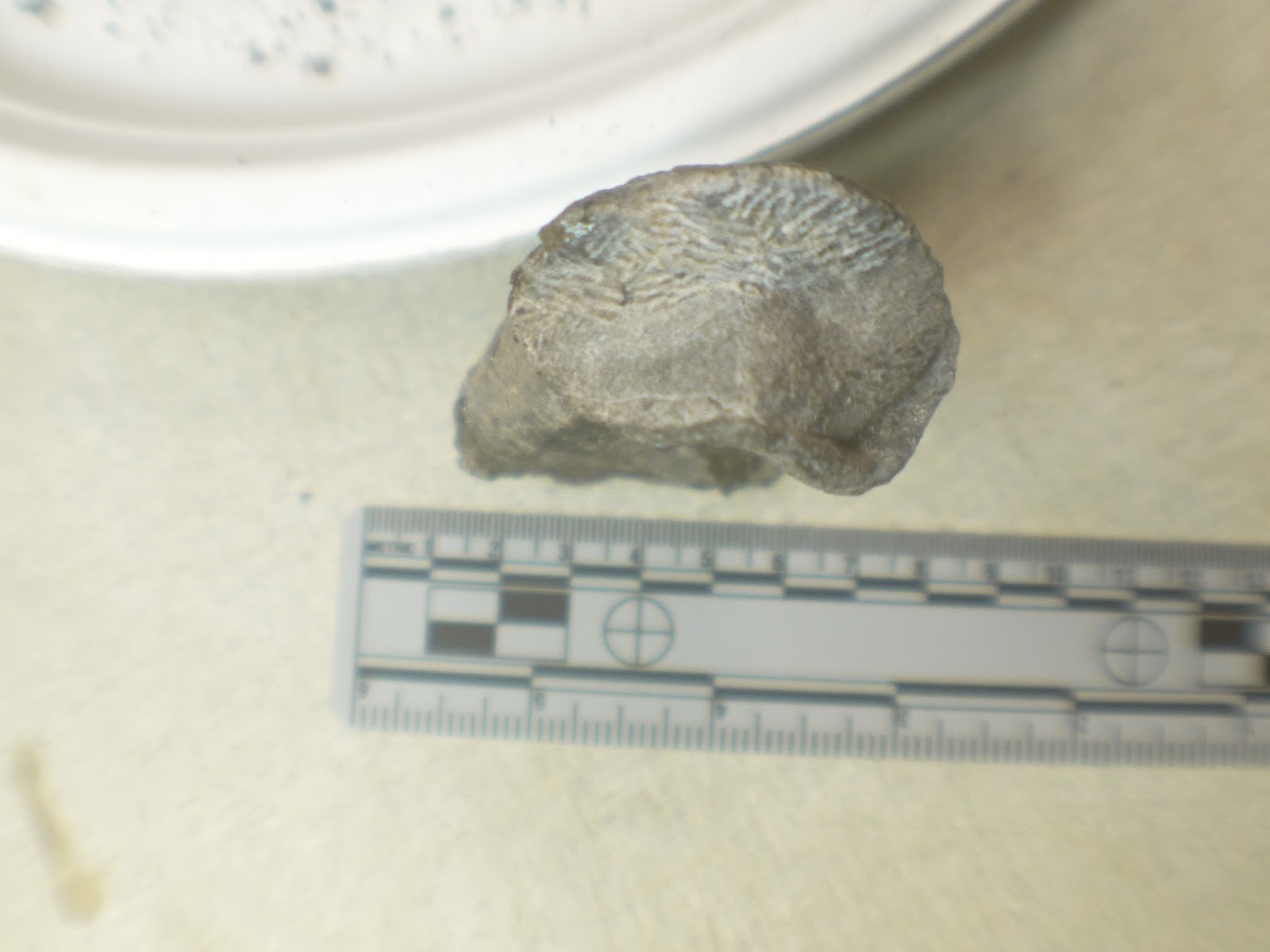
 Next we have yet another skull fragment. It shows some nice suture separation.


Here is where it fits on the skull - looking from the bottom side. It sets midline, around the eyeball orbit.


Last, here's another limb bone. The end closest to the outside of the concretion was difficult to prepare as somehow it lost color contrast with the matrix and the structure didn't show up well. At first I wondered if it was a piece of coral. It did turn out to be a rather nice limb bone, with the normal incompletely ossified ends that we find from this group of animals.


Now back to preparing another batch of centrums (one with a nice neural arch) 
Sincerely, Greg Carr